

7-OH products are sold in smoke shops, gas stations and online as if they were kratom, but they behave much more like prescription opioids. If you or someone you love can’t stop using 7-OH tablets, gummies or shots, this page explains what 7-OH is, why it’s so habit-forming, and what safe detox involves.
What Is 7-OH?
7-hydroxymitragynine, or 7-OH, is a compound found naturally in very small amounts in the kratom plant (Mitragyna speciosa). In kratom leaf it makes up less than 2% of total alkaloids. Manufacturers can also make it from mitragynine, kratom’s main alkaloid, in a single chemical step. The result is chemically identical to the natural form, but sold in far higher concentrations.
7-OH acts on the same brain receptors as morphine. The FDA describes it as a potent opioid, roughly 13 times more potent than morphine, and lab research shows opioid-like risks including tolerance, dependence and slowed breathing.
Concentrated 7-OH products are often marketed as “kratom”. Common street names include 7-Hydroxy, 7-OHMG and “7”.
7-OH vs. Kratom Leaf
| Kratom leaf | Concentrated 7-OH products | |
|---|---|---|
| Main active compound | Mitragynine | 7-OH, sometimes mixed with other synthetic alkaloids |
| 7-OH content | Trace amounts | Much higher; one review of 250 products found 1 mg to 700 mg per dose |
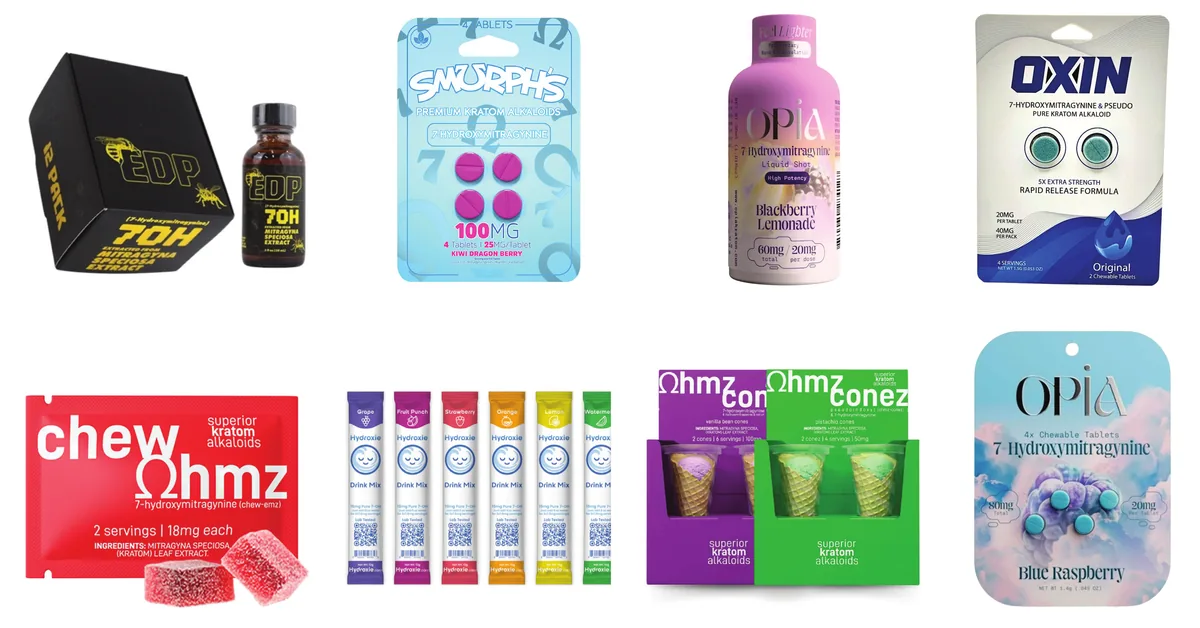
| Typical forms | Powder, capsules, tea | Chewable tablets, gummies, liquid shots, drink mixes, strips, vapes |
| How it acts | Milder, partial opioid-like effects | Potent opioid effects |
Some “enhanced” or “spiked” kratom products look like natural leaf but contain far more 7-OH than kratom naturally would. The FDA reports up to 500% more.
How to Recognize 7-OH Products
7-OH products are often designed to look like everyday treats: gummies, candy-colored tablets, fruit-flavored shots, drink-mix sticks, even ice-cream cones. Many labels call the product a “kratom extract” or a wellness supplement.
Check the label. If it lists 7-hydroxymitragynine, 7-OH or a specific number of milligrams of 7-OH, it’s a concentrated product, not plain kratom.
Is 7-OH Addictive?
Yes. 7-OH is a potent opioid, and regular use can lead to physical dependence. Many people describe a short-lived effect followed by a strong urge to take another dose, which can drive fast escalation.
Signs that use has become dependence:
- Needing more to get the same effect
- Feeling unwell when a dose wears off
- Using daily, or several times a day, just to feel normal
- Spending more money or time on 7-OH than you intended
- Trying to cut back and not being able to
7-OH Withdrawal Symptoms
People who stop using 7-OH may experience opioid-like withdrawal. Published case reports describe people who needed medically managed inpatient withdrawal after high-dose use, so don’t stop heavy use alone without speaking to a doctor.

Physical
Body aches, cold sweats, fatigue, stomach upset

Mood
Restlessness, irritability, anxiety, low mood

Sleep and cravings
Insomnia and strong urges to use again
Health Risks and Overdose
U.S. poison centers recorded 165 exposure cases involving 7-OH between January and July 2025. Among cases involving 7-OH alone, 35% led to serious health problems, including vomiting, confusion, seizures, a racing heart, high blood pressure and trouble breathing.
Because 7-OH is an opioid, naloxone (Narcan) can reverse a 7-OH overdose.
If someone is unresponsive or struggling to breathe, call 911 immediately. For a suspected reaction to a 7-OH product, call Poison Help at 1-800-222-1222. If you’re in crisis in the U.S., call or text 988.
The FDA states that no 7-OH product is FDA-approved, and that kratom-related products, including 7-OH, are not safe or approved treatments for opioid withdrawal, chronic pain, depression or anxiety.
Is 7-OH Legal? (Updated November 2026)
As of November 2026, the DEA is moving to make 7-OH a federally controlled substance:
- August 2026: three related synthetic compounds (mitragynine pseudoindoxyl, MGM-15 and MGM-16) were placed in Schedule I.
- 14 October 2026: the DEA announced its intent to temporarily place 7-OH in Schedule I when a product contains more than 1 mg per gram, more than 1 mg per mL, or an unusually high ratio of 7-OH to mitragynine.
- From 13 November 2026: the temporary order can take effect, lasting two years with a possible one-year extension.
- States: at least ten states, including Alabama, Indiana, Louisiana, Massachusetts, Tennessee and Wisconsin, already ban 7-OH, and others limit how much it may contain.
The DEA has stressed that products below the threshold should not be considered
safe.
7-OH Detox at Avante Ibogaine Institute
Because 7-OH acts on the same opioid receptors as other opioids, Avante treats 7-OH dependence within its clinical opioid detox program at our clinic in Nassau, Bahamas.
Before admission, every client completes medical screening, including an EKG and blood work, to confirm that ibogaine treatment is suitable. Treatment is supervised by our medical team, and stays run 5 to 15 days, with most averaging 6 to 8 days.
Withdrawal relief varies from person to person. Ibogaine treatment may significantly reduce withdrawal symptoms and cravings, and our clinical team plans aftercare support with each client before discharge.
To find out whether you qualify, call 1-844-4-AVANTE (1-844-428-2683) or US Direct (561) 531-0359, or complete our candidate qualification form.
7-OH Detox at Avante
Avante treats 7-OH dependence with the same medically supervised ibogaine protocol it uses for kratom and opioid detox at its clinic in Nassau, Bahamas.
- Medical screening first. Ibogaine has known cardiac risks, so every client completes intake forms, an ECG and lab work before admission. See our qualification criteria.
- Stabilization. The clinical team plans your transition off 7-OH before ibogaine is given.
- Supervised ibogaine treatment, with continuous medical monitoring.
- Recovery and aftercare planning for the weeks after you return home.
There are no published clinical trials of ibogaine specifically for 7-OH dependence yet. Our approach draws on the clinical team’s experience treating opioid and kratom dependence, and results vary from person to person. Learn more about withdrawal free detox and kratom addiction detox.
Frequently Asked Questions
1. Is 7-OH the same as kratom?
No. Kratom leaf contains mostly mitragynine with only trace 7-OH. Concentrated 7-OH products contain far more and act as potent opioids.
2. How long does 7-OH withdrawal last?
It depends on the dose and how long you’ve used it. Acute symptoms typically peak in the first few days, and some people have lingering cravings, low mood or poor sleep for weeks.
3. Can I quit 7-OH on my own?
Some people taper with medical help, but heavy users may need supervised detox. Talk to a doctor before stopping.
4. Is 7-OH a safe way to get off other opioids?
No. The FDA says kratom-related products, including 7-OH, are not safe or approved treatments for opioid withdrawal. 7-OH is itself an opioid.
5. Does naloxone (Narcan) work on 7-OH?
Yes. 7-OH is an opioid, and naloxone has reversed 7-OH overdoses. Call 911 first in any suspected overdose.
Ready to stop using 7-OH?
Talk to Avante’s admissions team about medically supervised detox in Nassau, Bahamas.
Sources
- U.S. Food and Drug Administration, Preventing the Next Wave of the Opioid Epidemic: What You Need to Know About 7-OH
- U.S. Food and Drug Administration, Products Containing 7-OH Can Cause Serious Harm
- Drug Enforcement Administration, Temporary Placement of 7 Hydroxymitragynine and Mitragynine Pseudoindoxyl in Schedule I, 91 FR 65370 (14 Oct 2026)
- Virginia Department of Health, DEA to Temporarily Schedule 7-OH
This page is for general information and is not medical advice. Do not stop or change substance use without consulting a qualified healthcare provider. In an emergency, call 911.